Worldwide Shipping

Signs Your Starting Motor Is Going Bad on Heavy Equipment

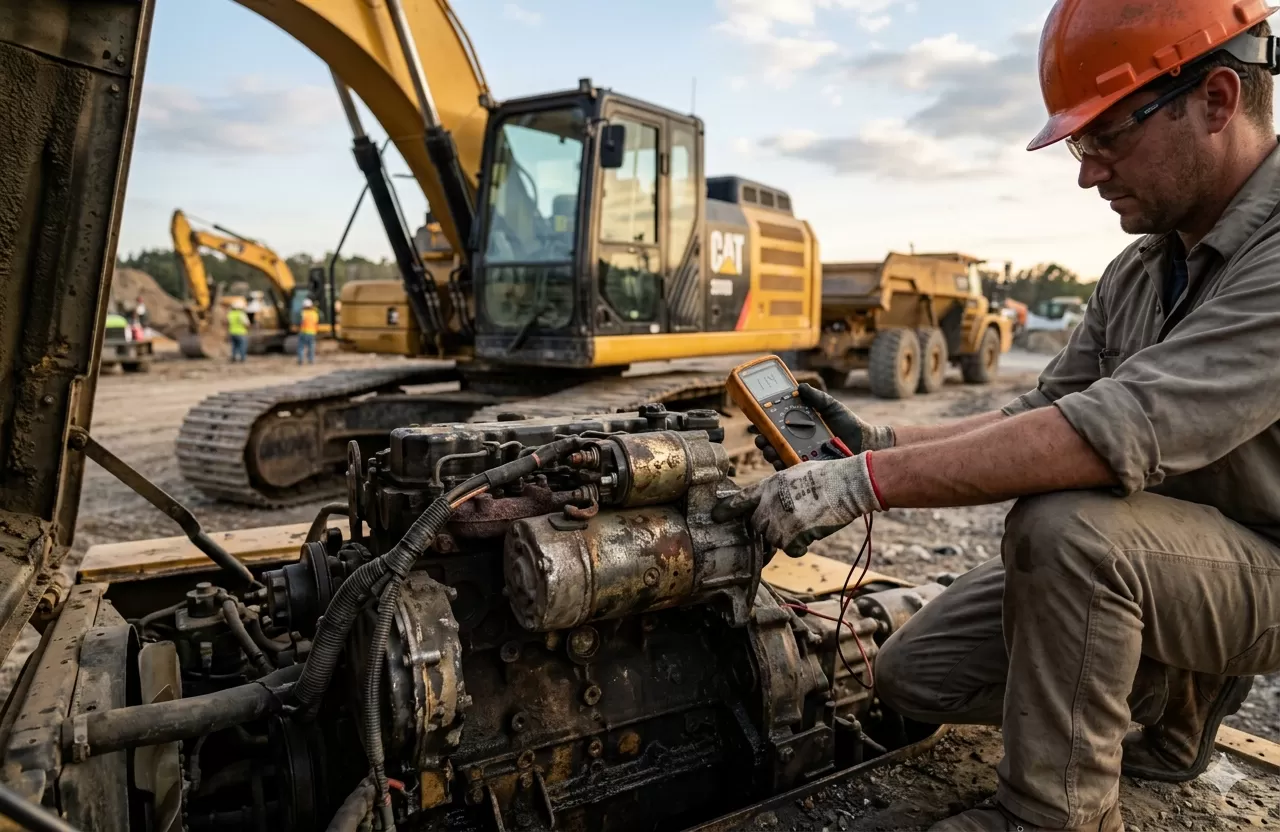
A heavy machine that won’t start on a Monday morning costs money the moment the engine doesn’t catch. Crews stand around. Schedules slip. The fault might be a $400 starter, a $200 battery, a $30 cable end, or a $40 connector — but until somebody diagnoses it, the machine produces zero revenue. The longer the diagnosis takes, the more expensive a small electrical problem becomes.
Most owners under-prioritize starter motor health because the starter sits at the bottom of the maintenance hierarchy. Engines get oil samples. Hydraulics get filter changes. The undercarriage gets daily walk-arounds. The starter gets ignored until the day it doesn’t crank. That’s a mistake. Starters rarely fail without warning — they degrade over hundreds of starts, throwing off subtle signals that a sharp operator catches days or weeks before the actual failure. Missing those signals is what turns a planned $500 replacement into a tow truck and a lost workday.
This guide is written for the contractors, fleet managers, and mechanics who’d rather hear the warning signs than hear silence at the key. It covers what a heavy-equipment starter does, the symptoms that point to a starter versus a battery versus wiring, the inspection rhythm that catches problems early, and how to source a replacement that holds up.
Quick answer: The most reliable starter motor failure signs on heavy equipment are slow cranking with a healthy battery, a single click when the key is turned, repeated rapid clicks, grinding during cranking, and freewheeling (motor spins but engine doesn’t turn over). Catching these early — before the starter quits entirely — turns a planned $400 to $1,200 replacement into a routine service item instead of an emergency call-out.
What a Heavy-Equipment Starter Motor Actually Does
The starter motor’s job sounds simple: spin the engine fast enough that compression generates the heat needed to ignite diesel fuel. The reality is a high-current, high-torque event that asks more of the starter in three seconds than most electrical components see in a month.
A typical heavy-equipment starter is a 12V or 24V DC motor that draws between 300 and 1,200 amps during cranking, depending on engine size. When the operator turns the key, three things happen almost simultaneously. The solenoid — a heavy-duty electrical switch mounted on the starter — receives a signal current from the ignition, closes its internal contacts to connect the battery to the starter motor armature through thick cables, and shifts the drive gear (sometimes called a bendix or pinion) forward to mesh with the engine’s flywheel ring gear. The motor spins, the flywheel turns, and combustion takes over.
Inside the starter, work is done by a wound armature rotating between heavy field coils, with electrical contact maintained through carbon brushes pressed against a copper commutator. Brushes are the most consistent wear point — sacrificial components designed to wear gradually over thousands of starts. When they’re gone, the contact path is gone, and the motor stops turning.
Diesel engines need a minimum cranking speed of roughly 150 to 200 RPM to build enough compression to fire. Anything less and the engine won’t catch, no matter how good the fuel. That makes the starter — and the entire starting circuit feeding it — one of the most consequential systems on the machine.
Why Starter Failures Cost More Than the Part
A replacement starter motor for typical heavy equipment runs between $300 and $1,500 in parts depending on machine class. Labour adds another $200 to $800 — more if the starter is buried under a fuel tank, transmission housing, or hydraulic lines.
That’s the cost when the starter dies cleanly. The expensive scenario is when it doesn’t.
A failing starter that drags, grinds, or freewheels under load can damage the flywheel ring gear — the toothed ring the starter drive engages with. A chewed-up ring gear turns a starter job into a clutch or flexplate removal, sometimes a transmission drop, and a ring gear replacement that can run $1,500 to $6,000 in labour alone. On configurations where the ring gear is integral to the flywheel, you’re looking at flywheel replacement instead.
Add downtime. A machine that won’t start during a heat wave or at the start of a frozen Monday shift costs revenue that can’t be recovered. Across a small fleet, heavy equipment starter problems that get ignored for weeks are some of the most expensive electrical issues a contractor will deal with.
The Inspection Routine That Catches Starter Problems Early
Most starter failures telegraph themselves for days or weeks before they happen. The trick is knowing what to listen for and what to look at. The check below takes under five minutes and catches the vast majority of pending issues.
Cranking sound and rhythm. Every machine has a normal cranking signature. Operators who run the same machine every day know what it sounds like. A change — slower, slightly raspy, hesitant — is the earliest warning sign and the cheapest one to act on.
Cranking duration. Track how long the engine cranks before catching. A machine that used to fire in 2 seconds and now takes 5 is telling you something. Could be glow plugs, could be fuel, could be the starter — but the trend is the warning.
Single click when turning the key. A solid clunk with no rotation usually means the solenoid is pulling in but the motor isn’t drawing current. Common cause is worn brushes, a damaged armature, or a failed solenoid contact disc.
Rapid repeated clicking. A machine-gun chatter from the solenoid almost always points to insufficient voltage at the solenoid. Battery, cables, or grounds — diagnose the supply side before condemning the starter.
Grinding during cranking. A grinding or harsh metal-on-metal noise during the crank means the drive gear isn’t meshing cleanly with the flywheel ring gear. Stop. Cranking through a grind chews up ring gear teeth fast.
Starter keeps spinning after engine fires. If the operator releases the key and the starter motor keeps running, the solenoid contacts are stuck closed or the drive isn’t retracting. Shut the machine off immediately — a starter that keeps engaging at engine RPM will destroy itself in under a minute.
Heat or burnt smell at the starter. Walk the machine after a hard start in hot weather. A starter that’s too hot to touch or has a faint electrical burn smell is in distress and on borrowed time.
Voltage drop at the battery during cranking. Use a multimeter at the battery terminals while cranking. Healthy systems show at least 10.5V under load on a 12V system, or roughly 21V on a 24V system. A larger drop points to battery, cable, or starter current draw issues.
Five minutes a week — especially on machines that sit overnight in extreme temperatures — catches almost every starter problem while it’s still cheap to fix.
Six Habits That Extend Starter Motor Life
Starter motors don’t fail in a vacuum. Most premature failures trace back to habits and conditions elsewhere on the machine. Six practices separate a starter that lasts the life of the engine from one that needs replacement at 3,000 hours.
1. Don’t Crank for More Than 15 Seconds at a Time
This is the single most violated rule on a job site. A starter is designed for short, high-current bursts — 10 to 15 seconds maximum, with at least a minute of cool-down between attempts. Continuous cranking past that window overheats the windings, fries the brushes, and warps the commutator. If the engine doesn’t fire after two attempts, stop and diagnose. Cranking for 30 seconds straight to “force it” is how starters die early.
2. Keep the Batteries Strong and Tested
A weak battery is the leading cause of premature starter failure. Low voltage means the starter draws more amps to spin the engine, which heats the windings, accelerates brush wear, and stresses the solenoid contacts. Test batteries under load at every service — not just resting voltage. A 12V battery that reads 12.6V at rest can still drop below 9V under cranking load and quietly destroy a starter in a season.
3. Inspect and Tighten Cable Connections
Loose or corroded connections between the battery, the solenoid, and the engine ground create voltage drops that force the starter to work harder for less torque. Pull the cable ends, clean the terminals, apply dielectric grease, and torque to spec at every major service. This costs nothing and prevents a meaningful share of “starter problems” that turn out to be a $5 cable end.
4. Don’t Ignore Slow Cranking
Slow cranking is never normal. It’s not “the cold.” It’s not “the machine getting old.” It’s a signal that something in the cranking circuit — battery, cables, ground, starter, or engine — is degraded. Acting on a slow crank when you first notice it costs a fraction of acting on it after the starter has died on a tight deadline.
5. Keep the Starter and Surrounding Area Clean
Heavy buildup of oil, dust, and debris on the starter body traps heat against the housing and masks early warning signs like seepage or burn marks. A clean starter is a starter you can actually inspect. A quick wipe-down at major services pays for itself.
6. Address Engine Drag Issues Promptly
A starter works harder on an engine with high oil viscosity, worn rings, or compression issues that increase cranking resistance. If a machine is being cranked harder than its peers to start in the same conditions, the engine is asking too much of the starter. Find the upstream cause — wrong viscosity oil, fuel dilution, compression loss — instead of waiting for the starter to fail.
Inspection and Service Intervals at a Glance
Different operating environments demand different rhythms. The intervals below are a practical starting framework; adjust based on machine conditions and OEM guidance.
|
Interval |
What to Check or Service |
Notes |
|
Every shift |
Cranking sound, cranking duration, any unusual noise at start |
Operator-led; 30 seconds |
|
Weekly |
Battery resting voltage, visible cable connections |
Multimeter at the battery terminals |
|
Every 250 hours |
Battery load test, voltage drop at solenoid during crank, ground integrity |
Same as a typical service interval |
|
Every 500 hours |
Clean starter housing, inspect cable terminals, torque check |
Tighten anything loose to spec |
|
Every 1,000 hours |
Starter amperage draw test under load |
Compare against OEM spec |
|
Every 2,000–4,000 hours |
Consider proactive starter rebuild or replacement on high-cycle machines |
Depends on starts-per-day, not just hours |
|
As needed |
Replacement when failure indicators present |
Don’t run a struggling starter to destruction |
Severe service tightens every one of these intervals. Generator sets that start dozens of times a day, equipment in deep cold, and machines in salt-air environments all wear starters faster than typical construction service. Adjust accordingly.
Reading the Signs: What Each Symptom Actually Means
A failing starter rarely speaks in just one symptom. The same signal can point to different root causes depending on the supporting evidence. Here’s how to read each one.
Slow cranking with a healthy battery. If the battery tests strong under load and the cables are clean but the engine still cranks slowly, the starter itself is the most likely culprit. Worn brushes, a glazed commutator, or partial winding failure all reduce torque output while still drawing current. Test the starter’s amp draw — a starter pulling significantly more amps than spec while producing weak rotation is on its way out.
Single click, no cranking. A solid clunk from the solenoid with no rotation usually means the solenoid is engaging but the motor circuit isn’t completing. Common causes: worn brushes that have lost contact with the commutator, a burnt solenoid contact disc, or an open winding in the motor. Less commonly, a seized engine or hydraulic lock will produce the same symptom. Bar the engine over by hand to rule that out before condemning the starter.
Rapid repeated clicking. A chattering solenoid almost always means insufficient voltage reaching the solenoid hold-in coil. The first suspects are the battery, the battery cables, and the ground path. A solenoid that can pull in but can’t hold against the spring will release, retry, release, retry — that’s the chatter. Diagnose the supply side first. Condemning the starter on a chatter is one of the most common misdiagnoses in the trade.
Grinding noise during cranking. A harsh metallic grind during the crank attempt means the starter drive gear isn’t meshing cleanly with the flywheel ring gear. Could be a worn drive (bendix), a damaged drive spring, a stuck solenoid plunger that isn’t shifting the gear fully forward, or — in worst cases — ring gear teeth that are already chewed up. Stop cranking immediately. Every additional grind costs ring gear teeth.
Starter spins but engine doesn’t turn over (freewheeling). The drive is engaging the motor but failing to grip the ring gear. Usually a worn one-way clutch in the drive assembly. The motor is fine; the drive is the problem. A starter rebuild or replacement is the fix.
Starter keeps running after the engine fires. Operator releases the key, engine is already running, but the starter motor is still spinning. The solenoid contacts are welded closed or the return spring has failed. Shut the engine off immediately — running the starter at engine RPM will destroy it in seconds and can throw the drive into the running flywheel.
Smoke or burning smell from the starter. A starter that smokes is a starter that’s been asked to do more than it can — usually long cranking sessions, low voltage, or a partial internal short. If smoke appears, stop cranking, disconnect the battery, and inspect. Continuing to crank a smoking starter usually ends in a fire.
Common mistake: Replacing the starter when the real problem is the battery, cables, or ground path. The most consistent diagnostic error in heavy-equipment electrical work is condemning the starter before testing the supply side. Always start with a battery load test, a voltage drop check at the solenoid, and a continuity check on the engine ground. A surprising percentage of “bad starters” turn out to be a $40 cable, a corroded ground strap, or a tired battery — diagnosed at the cost of a new starter that didn’t need to be installed.
When to Repair vs Replace
Starter motors are one of the few electrical components on heavy equipment where rebuilds are a legitimate option. The decision points below are worth knowing.
|
Condition |
Action |
Notes |
|
Worn brushes, otherwise healthy unit |
Rebuild — replace brush set |
Cheapest option; common at 3,000–5,000 hours |
|
Failed solenoid, motor still strong |
Replace solenoid only |
Often an in-the-field repair |
|
Drive gear or one-way clutch failure |
Replace drive assembly |
Done with starter off the machine |
|
Armature scored, commutator burnt |
Replace starter assembly |
Rebuilds rarely outlast a full replacement |
|
Internal short or smoking under load |
Replace immediately |
Rebuild is not safe; full unit replacement only |
|
Ring gear damage on engine |
Repair ring gear first, then replace starter |
Installing a new starter into a damaged ring gear destroys both |
|
Starter past OEM service life on critical machine |
Plan proactive replacement |
Reactive replacement costs more in downtime |
When replacing components, choose genuine or high-quality aftermarket parts that meet or exceed OEM specifications. Premium aftermarket starter motors and rebuild kits from established suppliers are engineered to the same torque, amperage draw, and duty cycle ratings as factory units, often at a meaningful cost saving — especially on older machines where OEM lead times can run into weeks.
Replacement Parts: What to Look For
Not every aftermarket starter is built the same. When sourcing replacement parts for heavy equipment starter problems, three things matter more than price alone.
Electrical specifications. A replacement starter has to match the engine’s voltage system (12V or 24V), torque output, and amperage draw. A unit rated below the engine’s cranking requirement won’t develop enough torque in cold weather; one with the wrong amperage signature can damage cables and ground paths over time. Reputable suppliers publish rated voltage, peak amperage, locked-rotor torque, and duty cycle. If those numbers aren’t on the product page, that’s the answer to your question.
Fitment data and pinion configuration. Starter motors are highly machine-specific. Mounting bolt patterns, pinion tooth count, pinion engagement direction, and overall housing dimensions vary not just by engine family but by build year and serial number range. A “fits multiple applications” listing is a warning sign. Look for parts cross-referenced to your exact engine model, equipment make, and serial number range — and ideally with an OEM part number cross-reference table on the listing.
Warranty and traceability. Starters are duty-cycle items that absorb real abuse. A clearly stated warranty — typically 12 months or a defined cycle count — backed by a supplier with documented batch traceability and a straightforward returns process is a sign of a vendor who stands behind the product. High-quality aftermarket components that meet or exceed OEM expectations should come with the paperwork to prove it.
A consistent supplier relationship also pays off in ways that don’t appear on the invoice — predictable stock on common starters and solenoids, fast cross-referencing across mixed fleets, and shipping speed on the parts that always seem to fail at the wrong moment.
Cold-Weather Starts, Hot Climates, and High-Cycle Service
Three operating environments deserve specific attention because they put unusual demands on the starter and the surrounding cranking system.
Cold-weather operation. Cold thickens engine oil, increases cranking resistance, and reduces battery output at the same moment. The starter does more work with less voltage. Use the correct cold-weather oil viscosity, keep batteries fully charged and load-tested, and consider a block heater on machines that sit overnight below freezing. A block heater that warms the engine to 40°F before a cold start reduces cranking load enough to add years to starter and battery life.
Hot-climate operation. Heat soaks into the starter housing from the engine block and exhaust manifold and degrades insulation, magnets, and bearing grease over time. On machines that run all day in extreme heat, inspect the starter housing for discolouration and brittleness at every service. Some installations benefit from heat shielding between the manifold and the starter — a cheap retrofit that meaningfully extends component life.
High-cycle service. Generator sets, equipment in start-stop intensive work, and machines that idle and restart frequently put far more cycles on the starter than typical excavator or dozer service. A starter that lasts 5,000 hours on a dozer might last 8 months on a job-site generator. On high-cycle applications, plan proactive replacement based on start count, not engine hours.
Building a Starter and Cranking-System Log
Most fleets keep oil and hour logs. Few keep records that are actually useful when an electrical problem develops. A useful cranking-system log captures three things on each major service: the cranking voltage drop at the battery and at the solenoid (under load), the starter amperage draw at room temperature, and the cranking duration before engine catch.
Over time, this becomes a wear curve for the electrical starting system. You see the slow rise in amperage draw months before the starter fails. You see the increasing cranking duration that points to a glow plug or compression issue. You catch the cable end whose voltage drop is creeping upward, three services before it causes a no-start. That single shift — from reactive to data-informed maintenance — meaningfully reduces electrical downtime across a fleet.
Bringing It Together
Recognizing starter motor failure signs is mostly a matter of paying attention. A starter rarely fails without notice. Cranking gets a little slower. The sound changes. A click appears that wasn’t there before. Fleets that catch those signals on the day they appear pay for a planned replacement. Fleets that wait pay for the starter, the tow, the lost shift, and sometimes the flywheel ring gear too.
The rule of thumb worth taking away: when a starter is doing something it didn’t do last week, diagnose it now. Diagnose the supply side first — battery, cables, grounds — before condemning the starter itself. A surprising percentage of starter complaints turn out to be a tired battery or a corroded ground that costs almost nothing to fix.
When the starter does need replacement, choose components — genuine or high-quality aftermarket — that meet or exceed OEM specifications, match the rated voltage and torque output, and come from a supplier who can document fitment and electrical specs. That’s how you get the full working life out of a starter, and how you avoid being the person standing next to a quiet machine on a busy morning.

About the Author

Related Posts
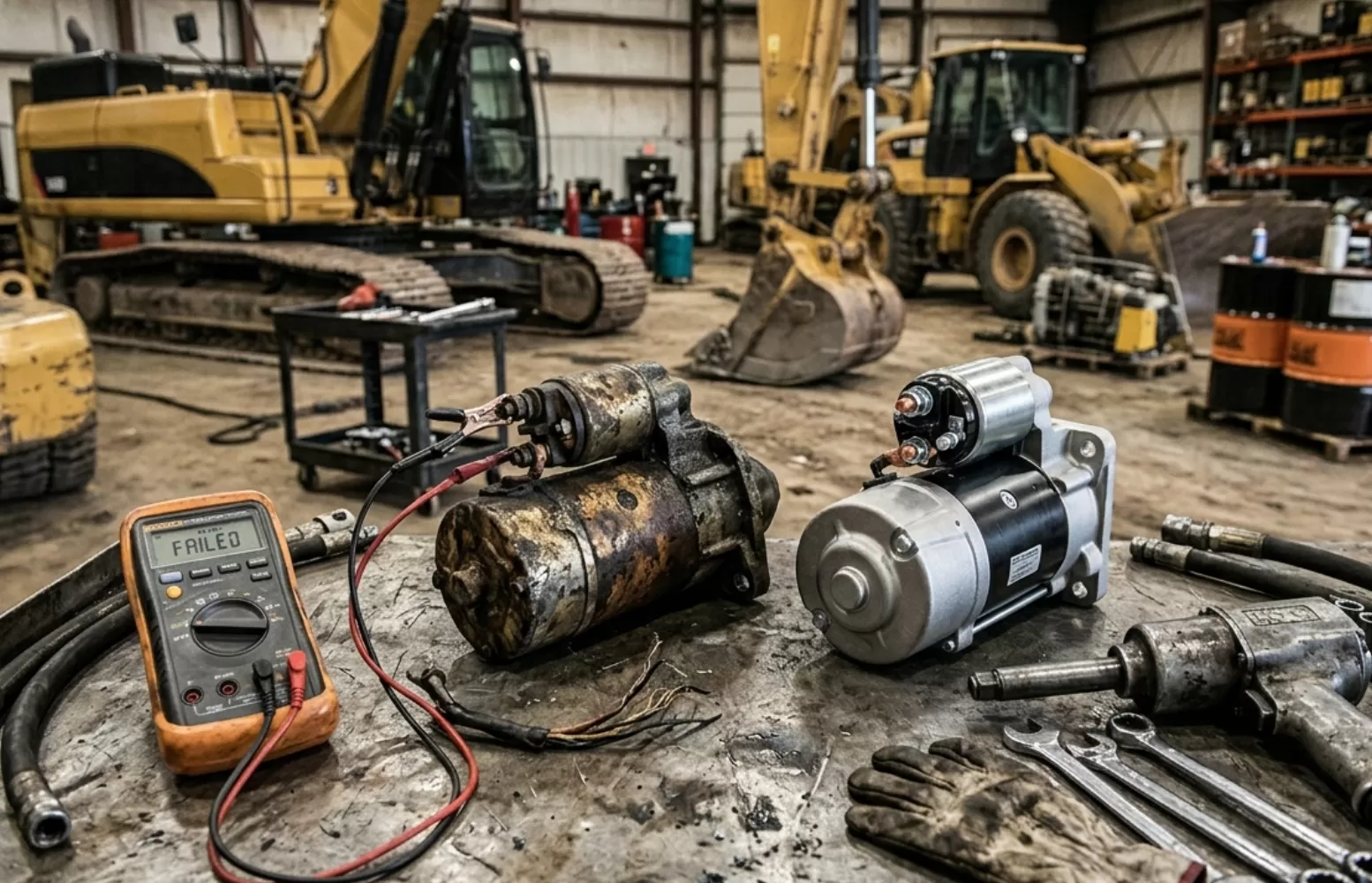
Starting Motor Failure: Diagnosis and Replacement for Heavy Machinery