Worldwide Shipping

A Complete Guide to Extending the Life of Your Undercarriage System

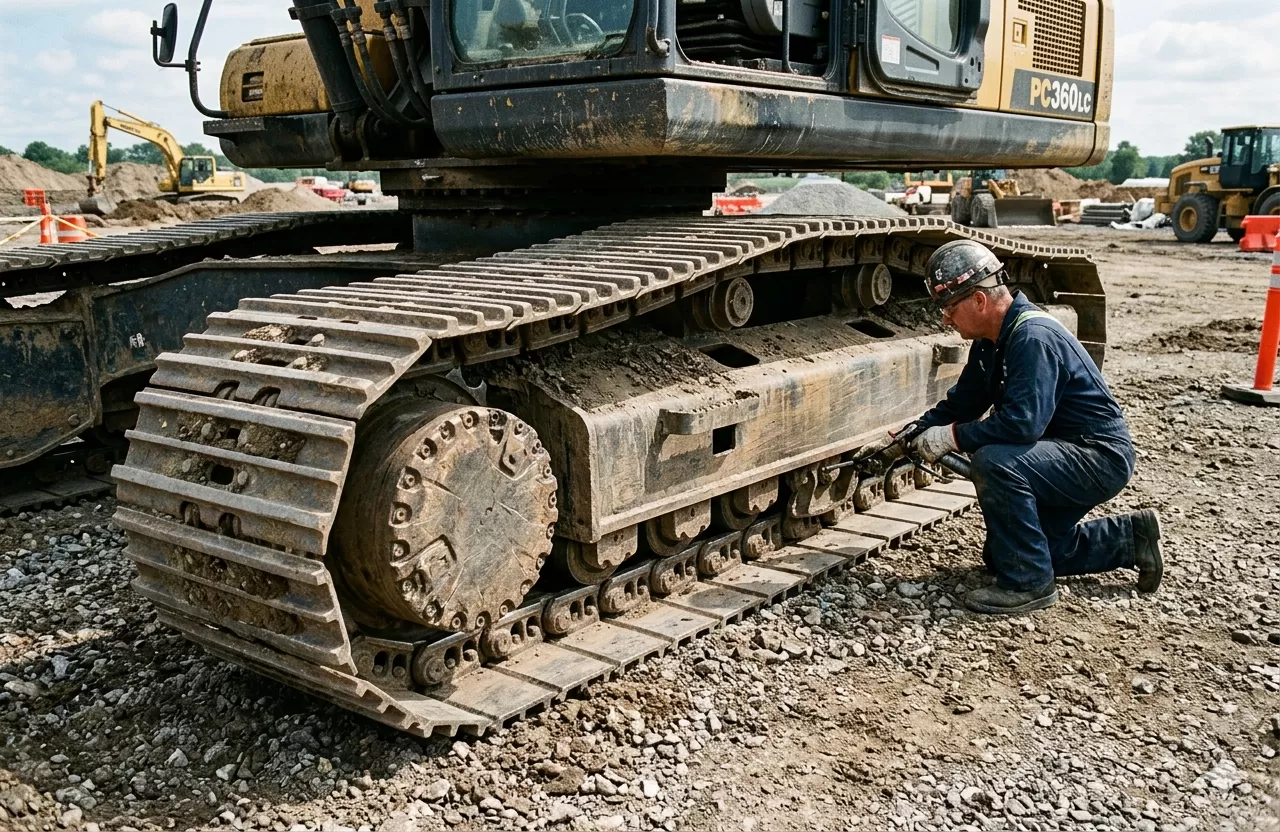
The undercarriage is the most expensive wear system on a tracked machine. On most excavators and dozers, it accounts for roughly half of all lifetime maintenance spending — more than the engine, more than the hydraulics, more than the bucket and attachments combined. And yet, it’s the system that gets the least attention until something breaks.
The reason is simple. The undercarriage is the part of the machine that touches the ground. It absorbs every rock, every grain of sand, every freeze and thaw cycle, every operator habit, good or bad. Wear is inevitable. The question is whether yours is wearing at a predictable, manageable rate — or whether it’s eating itself alive while you’re busy looking at other gauges.
This guide is written for the people who actually pay those repair bills: equipment owners, contractors, and fleet managers. It walks through what wears, why it wears, what to inspect, how to operate to slow that wear down, and how to make smart decisions about replacement parts when the time comes. The goal isn’t a perfect machine. It’s a track system that delivers the hours you paid for.
Quick answer: Most undercarriage failures are not caused by age. They’re caused by debris, incorrect track tension, poor operating habits, and skipped daily inspections. A consistent 10-minute end-of-shift routine and a properly sized set of components can extend undercarriage life by 30 to 50 percent over a neglected machine.
What the Undercarriage Actually Does
Before any maintenance conversation makes sense, it helps to understand what’s down there and what each part is being asked to do.
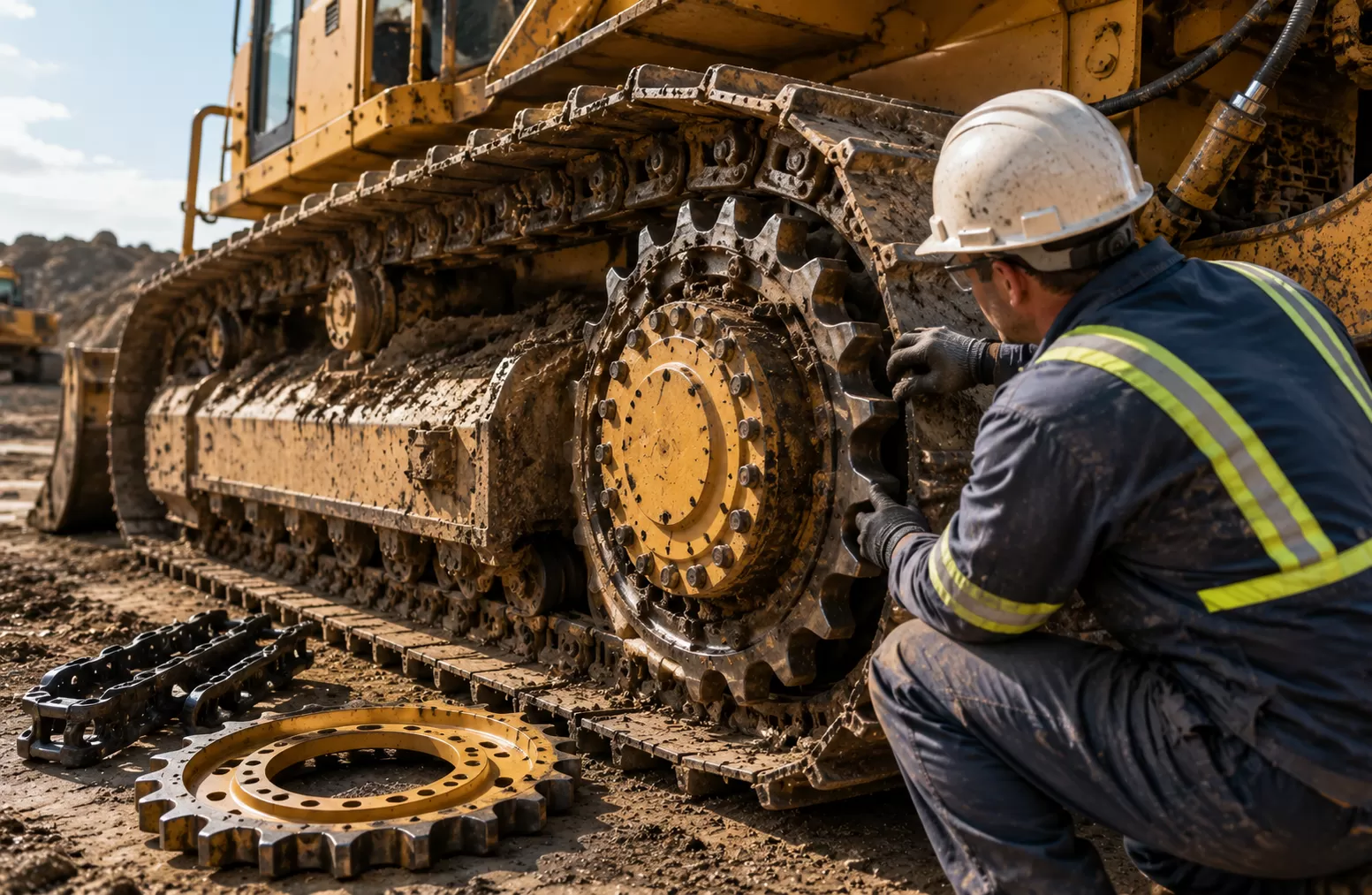
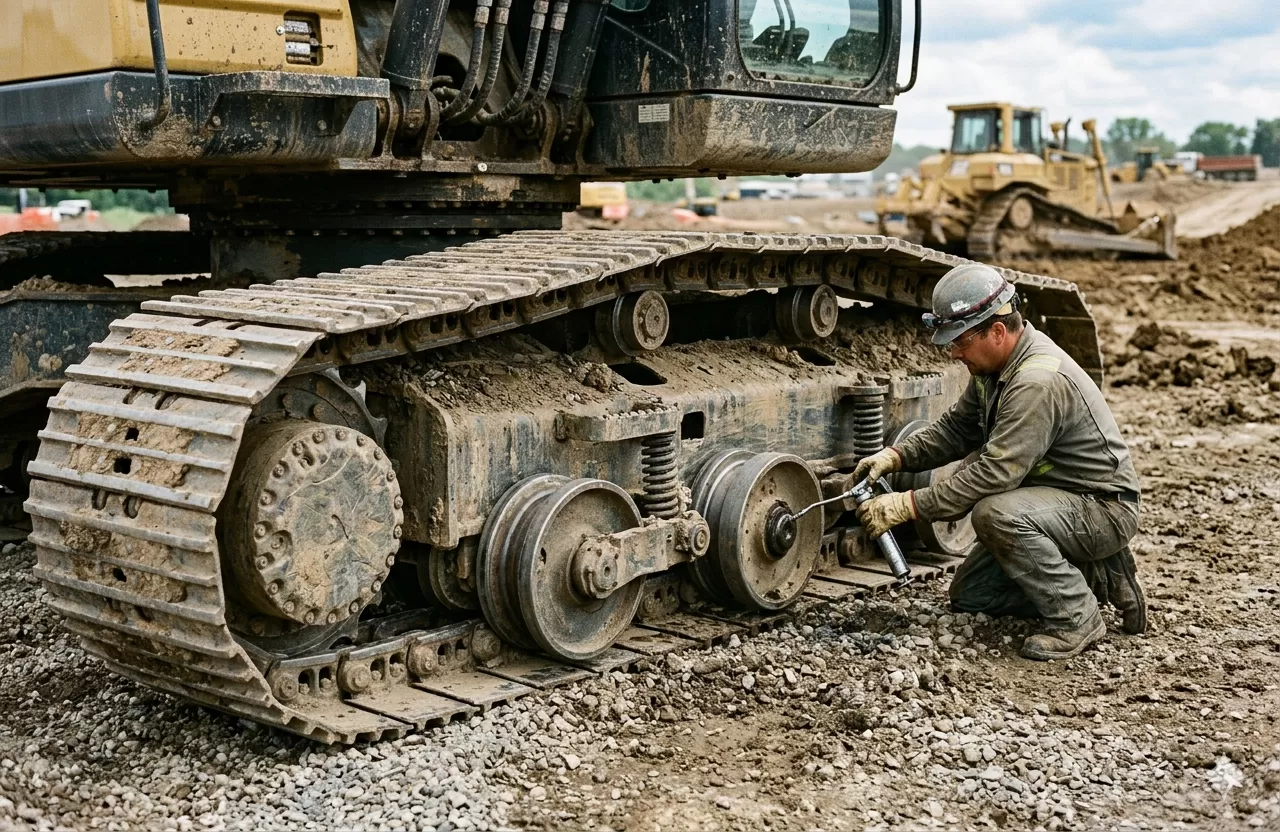
The undercarriage is a complete drivetrain hidden under the cab. The track chain is the spine — a long loop of linked steel sections held together by pins and bushings. The track shoes (or pads) bolt to the chain and provide the surface that touches the ground. The sprocket at the rear drives the chain, the idler at the front guides and tensions it, and the bottom rollers carry most of the machine’s operating weight.. The carrier rollers along the top keep the upper section of the chain from sagging.
When any one of these components wears unevenly, it accelerates wear on every other component. A worn sprocket carves into a new chain. A seized roller scuffs the rail. A loose track chain whips against the frame on every direction change. Undercarriage care is about keeping the whole system in balance, not just chasing the worst-looking part.
Why Undercarriage Wear Costs So Much
The numbers vary by manufacturer, but a useful industry rule of thumb is that the undercarriage represents 20 percent of a tracked machine’s purchase price and roughly 50 percent of its lifetime maintenance cost. On a mid-size excavator, a full undercarriage rebuild — chains, shoes, rollers, idlers, sprockets — can run between $25,000 and $60,000 depending on size and component grade.
What makes it expensive isn’t only the parts. It’s the labour and the downtime. A machine pulled out of service for a track chain replacement is typically off the job for two to four days. Multiplied across a small fleet, that’s revenue you can’t recover. This is why excavator undercarriage maintenance is the single highest-leverage habit a fleet manager can build. Five minutes of inspection a day is genuinely cheap insurance against five-figure repairs.
The Daily Inspection Routine
Most premature undercarriage failures show warning signs days or weeks before the actual breakdown. Operators who know what to look for catch the issue while it’s still a $200 fix instead of a $15,000 one.
A solid daily check covers the following points before and after a shift:
Debris in the tracks. Mud, clay, and rock packed between the chain and the frame are the leading cause of accelerated wear. Clean it out at the end of every shift, especially in cold weather where it will freeze and act like a wedge.
Track tension. Tracks that are too tight wear pins and bushings prematurely. Tracks that are too loose can de-track during a sharp turn. Both cost money. Check the sag against the manufacturer’s specification — typically a small, defined amount of slack at the top between rollers.
Oil leaks at rollers and idlers. A weeping seal on a roller is one of the cheapest early warnings you’ll ever get. Catching it early means a seal replacement. Ignoring it means a seized bearing and a damaged frame.
Sprocket tooth profile. Healthy teeth have a flat, blunt working face. When the teeth start to take on a sharp, hooked, or pointed shape, the chain is no longer indexing cleanly and you’re approaching replacement.
Track shoe condition. Look for cracks, missing bolts, bent edges, and grousers worn down to a stub. A single broken pad will damage the next one in line within hours.
Roller and idler rotation. Walk the machine slowly and watch the rollers turn. Anything that doesn’t rotate, or that wobbles, needs attention before the next shift.
This entire check takes under ten minutes once a crew gets the rhythm of it. It is, without exaggeration, the most cost-effective maintenance practice in the heavy equipment world.
The Six Habits That Actually Extend Track Life
Beyond inspection, a handful of operating and maintenance habits separate machines that last 6,000 hours on a set of tracks from machines that need a rebuild at 3,000.
1. Clean the Undercarriage Every Day
Pressure-washing or shovelling out packed material at the end of each shift is the single most impactful task an operator can do. Packed debris adds weight, jams moving parts, holds moisture against steel, and grinds away at sealed bearings. In cold climates, frozen debris is even worse — it can effectively lock components in place overnight.
2. Get the Track Tension Right
Both extremes hurt. Too loose, and the chain slaps the frame and risks coming off. Too tight, and you’re loading the pins, bushings, and idler bearings with constant force they were never designed to carry. Check tension on the surface and in the conditions you’ll be working in — a track tensioned correctly on a packed yard can be wrong by the time you hit soft mud.
3. Make Wide Turns
Pivoting in place on a tracked machine is the fastest way to wear out the side of a sprocket and tear up the track shoe edges. Wide, gradual turns distribute load evenly across both tracks and dramatically reduce side-load wear. This is pure operator habit, and it’s worth coaching.
4. Watch How You Work Slopes
Constant operation on the same hillside in the same orientation wears one side of the undercarriage far faster than the other. When the job allows, vary the direction of travel. Going up and down a slope, position the drive motor toward the back of the machine for cleaner power delivery and reduced track stress.
5. Dig Toward the Idler, Not the Sprocket
Digging back over the drive sprockets puts shock load directly into the most expensive components on the undercarriage. Whenever the job geometry allows, dig over the front idler. This is one of the most overlooked operating tips and it adds real hours to sprocket life.
6. Match the Track Shoe to the Ground
A wide shoe is built for flotation on soft ground. A narrow shoe is built for penetration and grip on hard or rocky ground. Running a wide shoe on rock sends concentrated force into the link assembly and accelerates track system wear dramatically. Running a narrow shoe in mud reduces flotation and over-stresses the chain. The right shoe for the conditions is one of the most under-appreciated maintenance decisions you can make.
Inspection Intervals at a Glance
Daily checks catch the obvious. Scheduled deeper inspections catch what daily walk-arounds miss.
|
Interval |
What to Check |
Notes |
|
Every shift |
Debris, leaks, track tension, visible damage |
5 to 10 minutes; operator-led |
|
Every 50 hours |
Lubricate pins and bushings (more often in wet conditions) |
Use heavy-duty, extreme-pressure grease |
|
Every 250 hours |
Lubricate idler and roller bearings; full visual inspection |
Pull the machine out of service for this |
|
Every 500 hours |
Measure pin and bushing wear; check chain pitch elongation |
Compare against OEM wear limits |
|
Every 1,000 hours |
Comprehensive undercarriage wear measurement |
Plan replacement parts based on findings |
The hour intervals above are starting points, not gospel. A machine working in abrasive volcanic soil or saltwater coastal conditions needs significantly more frequent attention than one working in clean topsoil. Follow OEM lubrication intervals and procedures. Many modern sealed track systems are factory-lubricated and do not require routine pin and bushing greasing
Reading Wear Patterns Before They Become Failures
Experienced operators learn to read the undercarriage the way a doctor reads a patient. The patterns tell you what’s wrong before any single component fails.
Uneven wear from side to side usually means the machine is being worked predominantly in one direction or on one type of slope. Rotate the work pattern when possible.
Sharp, hooked sprocket teeth mean the chain has elongated and is no longer engaging cleanly. The fix is rarely just the sprocket — it’s the sprocket and the chain together, in a coordinated replacement.
Flat spots on rollers indicate the roller has stopped rotating at some point and dragged. The cause is almost always a failed seal. Replacing the roller without fixing the underlying cause guarantees a repeat failure.
Cracks on the track shoe grousers suggest impact wear, often from operating on harder ground than the shoe was designed for. Consider a heavier-duty shoe profile on the next set.
Polished, shiny wear surfaces on rails or links typically mean the chain is operating without enough lubrication, or the lubrication is being washed out by water faster than it can be replaced.
Common mistake: Replacing only the worst-looking part. The undercarriage works as a system. Putting a brand-new sprocket on a worn chain, or new chain on worn rollers, accelerates wear on both. Plan replacements in coordinated sets whenever the wear data supports it.
When to Repair and When to Replace
Knowing when a component is “done” is half the skill of running an efficient fleet. The general benchmarks below are guidelines — always verify against the OEM wear limits for your specific machine.
|
Component |
Replace when |
Notes |
|
Track chain |
Replace when wear measurements exceed OEM limits. (On average, when pitch elongation exceeds 3% of new dimension) |
Rotate pins and bushings if wear is still minimal |
|
Sprocket teeth |
Teeth are sharply hooked, pointed, or chipped |
Replace in coordination with chain |
|
Track rollers |
Bearings seized, seals failed, or diameter worn 10%+ below spec |
A weeping seal is the early warning |
|
Idlers |
Surface worn, bearings noisy, or flange damaged |
Often outlasts rollers but inspect at the same intervals |
|
Track shoes |
Grousers worn flat, shoes cracked, bolts broken |
Replace cracked shoes immediately — they damage neighbours |
|
Carrier rollers |
Wobble, noise, or visible seal failure |
Less load than bottom rollers; longer typical life |
When replacing components, choose genuine or high-quality aftermarket parts that meet or exceed OEM specifications. Premium aftermarket undercarriage components from established suppliers are engineered to the same fitment, hardness, and durability standards as factory parts, often at a meaningful cost saving — particularly for older or mixed fleets where OEM lead times can be a problem.
Replacement Parts: What to Look For
Not all aftermarket parts are created equal. When sourcing replacement undercarriage components, three things matter more than price alone.
Material specifications. Track pins and bushings need to be heat-treated to specific hardness profiles. Reputable aftermarket suppliers publish their hardness, induction depth, and material grade. If a supplier won’t share that data, that’s the answer to your question.
Fitment data. Undercarriage components are machine-specific down to small dimensional tolerances. A “fits most excavators” listing is almost always a red flag. Look for parts cross-referenced to your exact make, model, and serial number range.
Warranty and traceability. A clear warranty term — typically 6 to 12 months or a defined hour limit — and a documented batch traceability process are signs of a supplier who stands behind the product. High-quality aftermarket parts that meet or exceed OEM expectations should come with the paperwork to prove it.
A consistent supplier relationship for heavy equipment undercarriage parts also pays off in ways that don’t show up on the invoice. Cross-referencing across multiple machines, predictable stock levels, and faster shipping on common wear items all reduce downtime more than any single discount.
Cold-Weather and Coastal Conditions
Two operating environments deserve special attention because they accelerate undercarriage wear in ways that catch operators off guard.
Cold weather. Below freezing, any mud, water, or debris left in the undercarriage will freeze solid overnight. In the morning, that frozen material can lock rollers, crack seals on first movement, and put shock loads through the chain. The non-negotiable winter routine is: clean before parking, every single shift. It takes longer in cold weather, and it’s worth every minute.
Coastal and high-moisture environments. Saltwater accelerates corrosion on every steel surface. Daily fresh-water rinsing of the undercarriage extends component life significantly. Consider applying a rust-inhibitive coating to the frame and guards after cleaning. Replace seals more aggressively in these environments — the cost of a seal is nothing compared to the cost of the bearing it protects.
Building a Maintenance Log That Actually Helps
Most fleets keep some form of maintenance log. Most of those logs are useless when something goes wrong, because they record what was done without recording what was found.
A useful undercarriage log captures three things on each inspection: the operating hours at inspection, the measured wear or condition of each major component, and any corrective action taken. Over time, this turns into a wear curve. You stop replacing parts because they look worn and start replacing them because the data tells you their working life is up. That single shift in approach often reduces parts spending by 15 to 25 percent across a fleet, because nothing is being thrown out early and nothing is being run to destruction.
Bringing It Together
The undercarriage rewards attention more than almost any other system on a tracked machine. The maintenance is not difficult. The inspections are not time-consuming. The operating habits are not complicated. What’s required is consistency — the same checks, the same cleaning, the same coaching, every shift, every machine, every season.
Fleets that build that consistency see their tracks last longer, their downtime drop, and their parts spending become predictable instead of catastrophic. Fleets that don’t, pay the difference. The math is rarely closer than that.
When the time comes for replacement, choose components — genuine or high-quality aftermarket — that meet or exceed OEM specifications, source them from a supplier who can document fitment and material specs, and plan the replacement as a coordinated set rather than a series of one-off repairs. That’s how you get the full working life out of an undercarriage. Anything less is leaving hours on the ground.

About the Author

Related Posts
Rolling Strong: How to Maximize the Lifespan of Your Undercarriage Bogie Assembly